Not money.
Not software.
Time.
Think about a normal company.
A customer sends an email on Saturday.
Monday morning, someone opens the inbox.
They read it.
Reply.
Wait for the customer.
Reply again.
Calculate the price.
Prepare the quotation.
Create the invoice.
Send it.
Wait for payment.
Nothing is broken.
Nobody is doing anything obviously wrong.
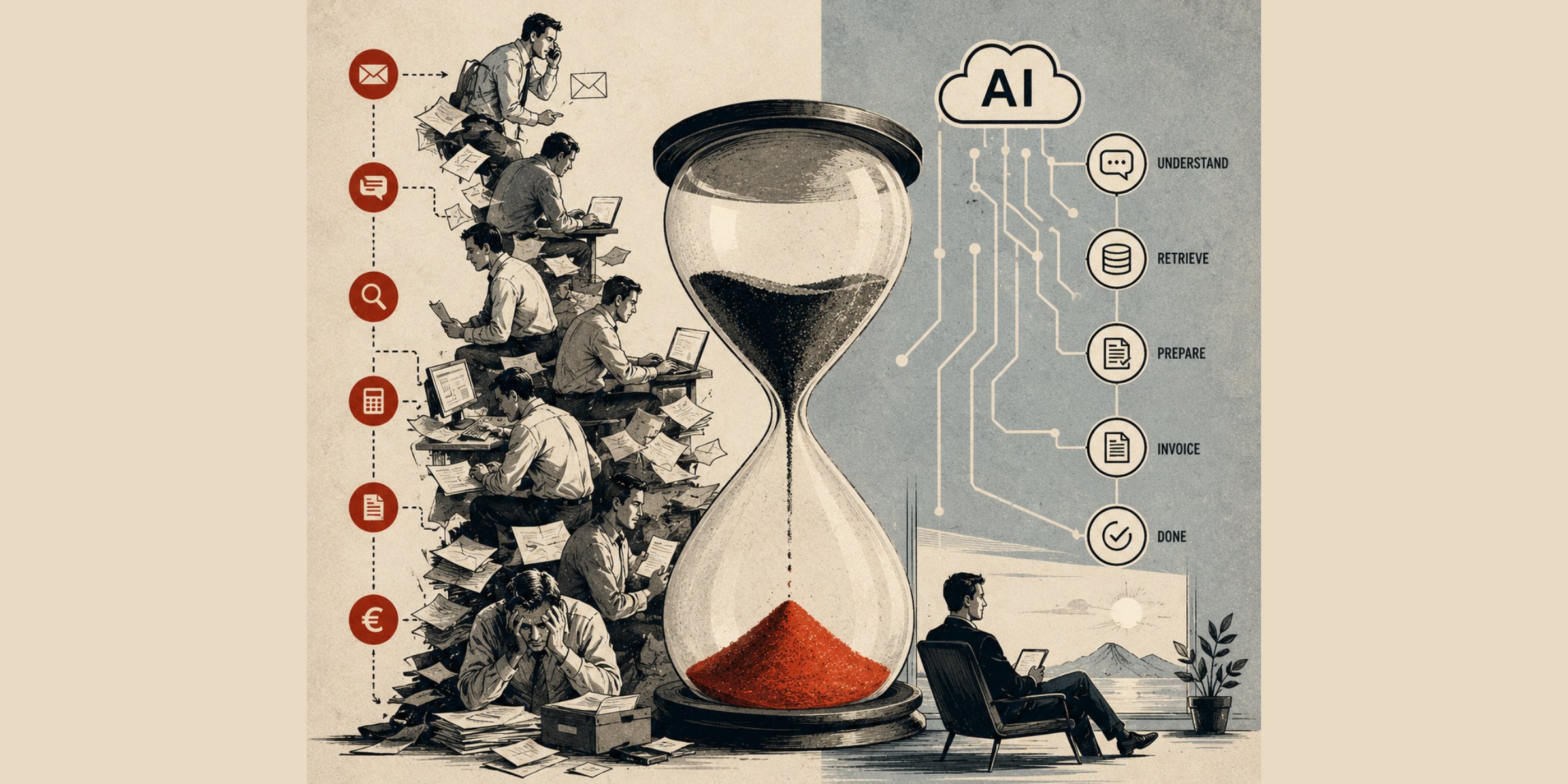
But six or seven human interactions just happened to move one customer from “I want this” to “here is your invoice.”
Now imagine that most of that happened automatically.
The customer gets a response on Saturday.
The system understands what they need.
It checks the relevant information.
Prepares the quotation.
Creates the invoice.
The right person gets notified only when it is actually needed.
Monday morning, the founder isn’t spending the first hour cleaning up yesterday’s communication.
They open their phone.
AI bot:
Orders.
Revenue.
Customers.
Problems.
Growth.
And then they think about tomorrow.
This is where I think we are entering one of the biggest business opportunities of our era.
Not because companies need another chatbot.
Because we can finally start removing the invisible work that has been consuming companies for decades.
The designer who spends hours moving information between tools.
The salesperson answering the same questions every day.
The accountant processing information that already exists somewhere else.
The manager checking five systems just to understand what happened yesterday.
The founder solving problems that shouldn’t require the founder.
AI can connect these pieces.
And increasingly, AI agents can actually do the work between them, rather than simply tell someone how to do it.
McKinsey’s 2025 research found that 88% of organizations were already using AI in at least one business function, while only 7% reported having fully scaled it across the organization.
That gap is the opportunity.
The next advantage won’t necessarily belong to the company that uses the most AI.
It will belong to the company that removes the most unnecessary work.
Give people their time back.
Give the founder time to think.
Give the team time to create.
Give customers faster answers.
Give the business more capacity without simply adding more people.
That’s the kind of AI automation I’m interested in.
Conclusion
Not making people work faster.
Making less unnecessary work exist in the first place.
Create an environment where creativity flourishes.